

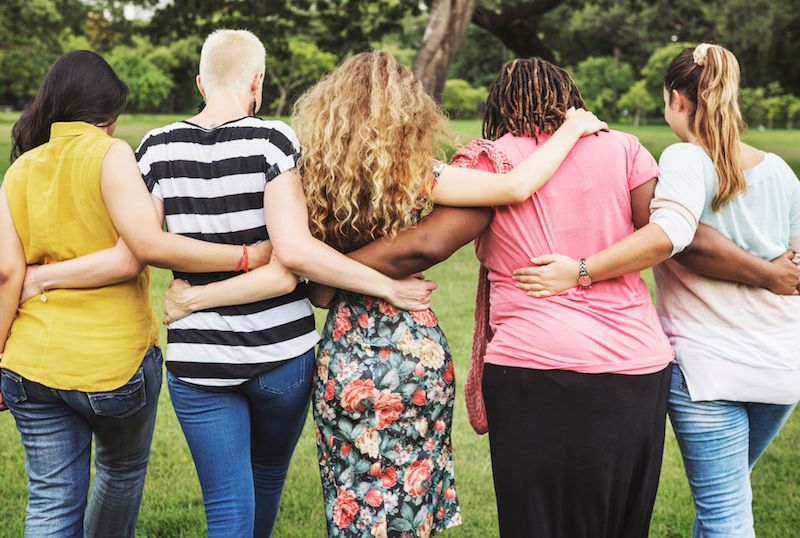
The Science Behind Why Giving Feels Good
You've probably felt it before — that quiet lift after doing something kind for someone else. Maybe you dropped off food for a neighbor, volunteered your Saturday morning, or gave to a cause that mattered to you. Whatever the form, the feeling tends to be the same: a sense of warmth, of rightness, of something that can't quite be explained by logic alone.
As it turns out, science has quite a bit to say about why.
Your Brain on Generosity
Researchers have studied the neurological effects of giving for decades, and the findings are surprisingly consistent: acts of generosity activate the same reward pathways in the brain as food, social connection, and other fundamental human pleasures.
A 2006 study published in the Proceedings of the National Academy of Sciences found that when participants donated to charitable organizations, the brain's mesolimbic system — sometimes called the "reward center" — was engaged in the same way it responds to monetary rewards. This is the same region associated with pleasure, trust, and social bonding.¹ The brain, in other words, doesn't distinguish much between receiving something good and giving something to someone else.
Some researchers have called this the "helper's high" — a mild, sustained sense of wellbeing that follows a generous act. Unlike the quick spike of pleasure from, say, buying something new for yourself, the warmth from giving tends to linger.
It Reduces Stress, Too
Generosity doesn't just feel good in the moment — it appears to work as a buffer against stress. A 2013 study published in the American Journal of Public Health found that people who gave support to others were significantly buffered from the harmful effects of stress, including elevated mortality risk, compared to those who did not.² The act of helping others, it seems, recalibrates how stress moves through us.
There's also evidence that giving shifts our attention outward. Stress, anxiety, and rumination are often self-focused states. Directing energy toward someone else's needs — even briefly — can interrupt that cycle and offer a different kind of perspective.
The Social Dimension
Humans are deeply social animals. Our brains are wired to track our relationships with others, to feel the pain of exclusion, and to feel the reward of connection and belonging. Generosity, at its core, is a form of social bonding.
Research from the Greater Good Science Center at UC Berkeley — which synthesizes decades of studies on altruism, empathy, and well-being — consistently finds that giving to others strengthens our sense of connection to the people and communities around us.³ It signals, both to ourselves and to others, that we are part of something larger than ourselves. That signal matters: studies consistently link strong social ties to better health outcomes, longer lifespans, and greater overall life satisfaction.
In this sense, giving isn't purely altruistic. It's also deeply self-reinforcing, in the best possible way.
Why Local Giving Hits Differently
There's an interesting wrinkle in the research: giving tends to feel more meaningful when the connection to impact is visible or tangible. When you can imagine the person your generosity reaches — when the distance between giver and recipient is short — the emotional reward is stronger.
This may explain why so many people who give to local organizations describe a particular sense of fulfillment. You're not sending a check into the abstract. You're contributing to your own community, to people who live near you, who may shop at the same stores or walk the same sidewalks.
The act takes on a different quality. It feels less like a transaction and more like a relationship.
What This Means for All of Us
None of this is to say that generosity is purely self-serving, or that the people who benefit from it matter less than how good it makes the giver feel. The impact is real on both ends. But understanding the science of why giving feels good does offer something useful: it reminds us that generosity is not a sacrifice of something we have. It is, in many ways, a gift we give ourselves, too.
The impulse to help is not weakness or naivety. It's one of the most deeply human things there is.
Aster Aging has been supporting older adults in the East Valley since 1979. Our programs — including Meals on Wheels, Senior Centers, In-Home Support, and Outreach & Social Services — are made possible in part through the support of community members like you. If you'd like to learn more about how you can support the work we do, read more here.
Notes
¹ Moll, J., Krueger, F., Zahn, R., Pardini, M., de Oliveira-Souza, R., & Grafman, J. (2006). Human fronto–mesolimbic networks guide decisions about charitable donation. Proceedings of the National Academy of Sciences, 103(42), 15623–15628. https://doi.org/10.1073/pnas.0604475103
² Poulin, M. J., Brown, S. L., Dillard, A., & Smith, D. M. (2013). Stress does not predict increased mortality among those who give to others. American Journal of Public Health, 103(9), 1649–1655. https://doi.org/10.2105/AJPH.2012.300876
³ Greater Good Science Center at UC Berkeley. Research on generosity, altruism, and social well-being. https://ggsc.berkeley.edu/what_we_do/research


