

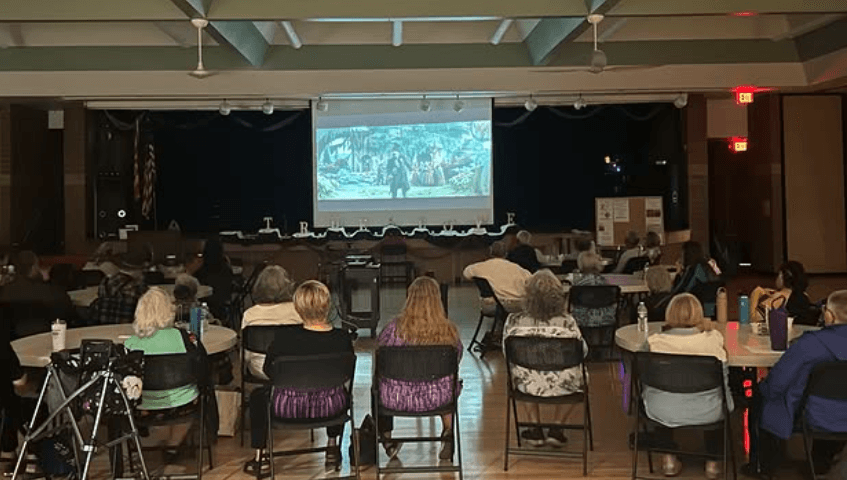
Catch a Movie at the Senior Center In June
A month of music, mischief, history, and second chances
June’s Senior Center movie lineup moves across decades of American storytelling, from wartime strategy to beachside comedy, from screwball romance to stories about homecoming and reinvention. Some films are polished Hollywood classics, others are lighter summer fare, and a few are curiosities from earlier and later eras of television and film.
The common thread is simple: people trying to figure out where they belong.
All movie screenings are free, and every attendee gets a bag of free popcorn.
Screenings are held weekly throughout June.
Week 1 — June begins with spectacle and history
June 2 | Midway (1976)
Midway
The month opens far from the beach or ballroom, in the middle of the Pacific Ocean during World War II.
This is a large ensemble war film built around one of the most important naval battles in U.S. history. The Battle of Midway was not just a clash of fleets, but a turning point shaped heavily by intelligence work. The film emphasizes that quieter side of war: codebreaking, intercepted messages, and the fragile timing that determined survival.
It is structured with the gravity of 1970s historical cinema, where strategy and human exhaustion matter as much as combat.
June 4 | Seven Brides for Seven Brothers (1954)
Seven Brides for Seven Brothers
From war rooms to wide-open frontier country, the tone shifts sharply.
This Technicolor musical is built on movement, both literal and social. A bride arrives expecting a quiet life and instead finds herself in a household of seven brothers who behave more like a pack than a family. What follows is not just romance, but a full-scale effort to civilize chaos.
The film is remembered less for dialogue than for choreography: barn-raising sequences, coordinated dances, and an almost athletic energy that defines mid-century Hollywood musicals.
Week 2 — Reinvention, youth culture, and early cinema storytelling
June 9 | The Greening of Whiney Brown (1911)
The Greening of Whiney Brown
This early silent-era title reflects a very specific storytelling tradition: the “city to country” moral transformation narrative.
A privileged urban character loses their social footing and is forced into rural life, where the absence of comfort becomes the setting for personal change. These films were often less about plot complexity and more about visual contrasts: polished interiors versus open land, entitlement versus labor, and isolation versus community.
Whether presented as archival material or reconstruction, it represents the earliest language of American moral cinema.
June 11 | Beach Party (1963)
Beach Party
Now the calendar jumps forward half a century in tone, if not in philosophy.
This film helped define the beach comedy genre: teenagers on surfboards, constant music, and a world where adult concerns barely register. The story is loosely built around young couples arguing, reconciling, and repeating the cycle under the sun.
A visiting anthropologist attempts to study “youth behavior,” which gives the film its gentle joke: the adults are the ones trying to make sense of a world that refuses to be serious.
It is deliberately unserious cinema, which is exactly its appeal.
Week 3 — Romance as competition, disguise, and reinvention
June 16 | Breakfast for Two (1937)
Breakfast for Two
This is classic screwball comedy structure: wealth, ego, and romantic pursuit colliding at high speed.
A wealthy heiress inserts herself into the life of a struggling businessman, not as a passive romantic interest, but as an active force who refuses to leave until she reshapes the situation entirely. Romance here is not gentle. It is argumentative, strategic, and driven by verbal sparring.
The era’s comedies often treated love as negotiation. This film is firmly in that tradition.
June 18 | Clambake (1967)
Clambake
By the late 1960s, the formula has shifted but the themes remain familiar: identity, wealth, and the question of whether anyone can be loved without status attached.
An oil heir trades places with a working water-ski instructor, stepping into a life where he is no longer defined by money. The disguise plot allows the film to test a simple idea: whether affection survives without advantage.
Like many Elvis Presley vehicles, it blends musical interludes with light comedy and an underlying tension between appearance and authenticity.
Week 4 — Homecoming, chaos, and second chances
June 23 | A Place to Grow (1995)
A Place to Grow
This contemporary drama returns the series to questions of home and inheritance.
A country singer comes back to the family farm after a death that does not fully make sense. What begins as grief becomes a dispute over land, memory, and what should be preserved versus sold.
These narratives tend to work on two levels: the emotional weight of family history, and the economic pressure of maintaining it.
June 25 | Beach Blanket Bingo (1965)
Beach Blanket Bingo
If Beach Party is the blueprint, this is the escalation.
The beach setting remains, but the plot becomes more exaggerated: skydiving, kidnapping, romantic confusion, and increasingly improbable scenarios stitched together by music and momentum rather than logic.
It is part of a cinematic world where summer is permanent, consequences are temporary, and everything resolves in song.
June 30 | Second String (2002)
Second String
The month closes in modern territory with a sports comedy built on disruption.
When an entire professional football offense is sidelined by food poisoning, a backup quarterback is forced into the central role. What follows is a familiar underdog structure: an unlikely chance, sudden responsibility, and the pressure of performing under conditions no one prepared for.
It is less about football than about substitution, timing, and stepping into a role no one expected you to occupy.
Closing shape of the series
Taken together, the month traces a loose arc: survival and strategy in war, order emerging from chaos in musicals, identity disguised or tested in comedies, and finally return and replacement in modern dramas.
Across ninety years of filmmaking, the underlying preoccupation barely changes: people trying to figure out who they are when circumstances stop cooperating.


